
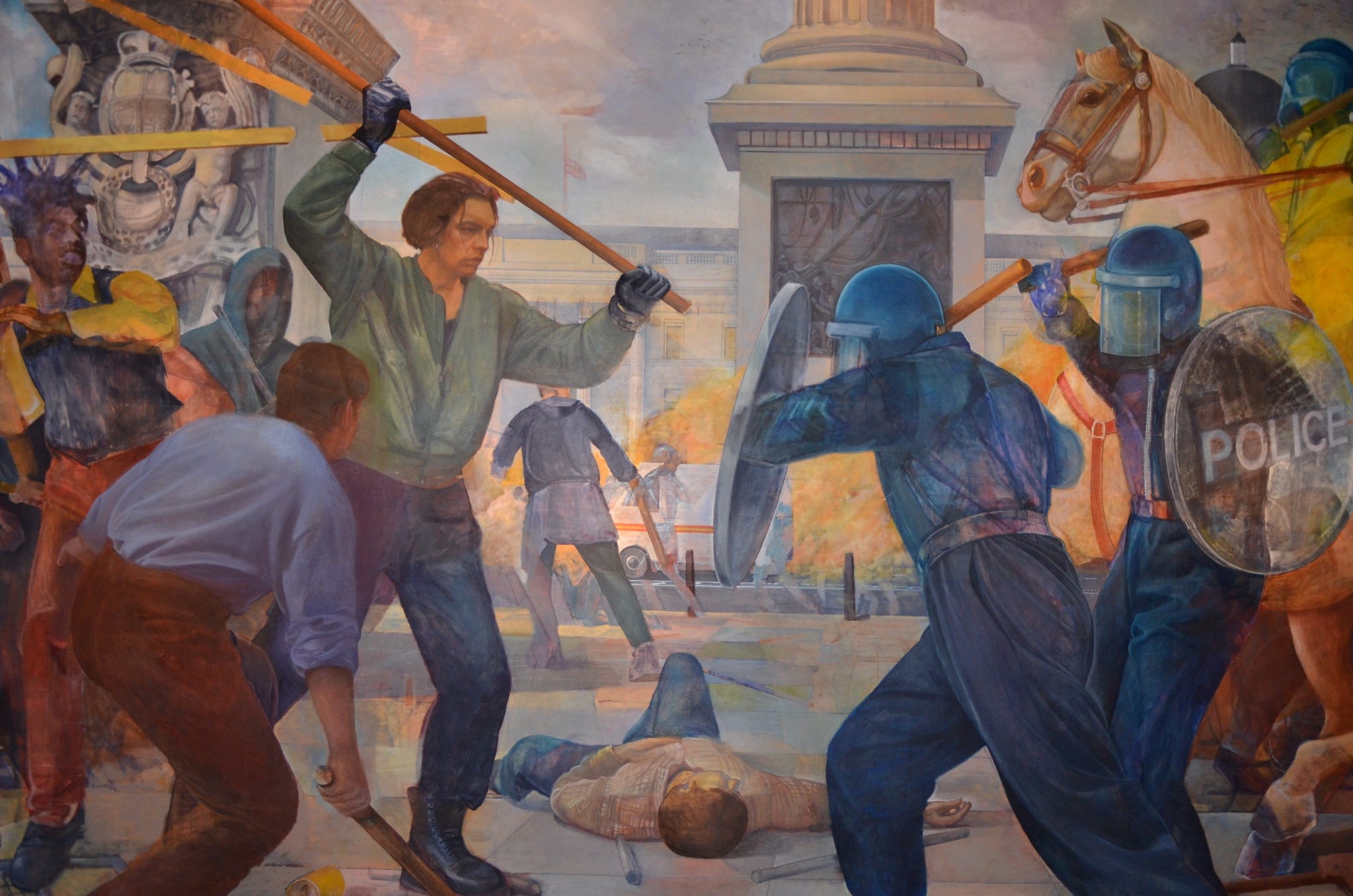
John Bartlett’s “History Painting” (1993-94), depicting the 1990 Poll Tax riot.
I write often about public order policing, parapolitics and “domestic extremism.” The dynamics of public unrest fascinate me; the actors involved, from politicians, activists, media and (of course) the police all speak to how democracies manage - or fail to manage - instances of tumultuous change. Now, are we’re seeing another turn of the post-1968 wheel, one possibly heralding the potential “Ulsterisation” of mainland Britain and an era of sectarian strife?
This piece, which is far from exhaustive, provides a brief overview of the most consequential instances of English public disorder since the Grosvenor Square riot in, yes, 1968. They’re presented chronologically, rather than in order of their perceived significance. Today’s post covers the period up to 1990. The next will consider 1990-2026.
Grosvenor Square, 1968
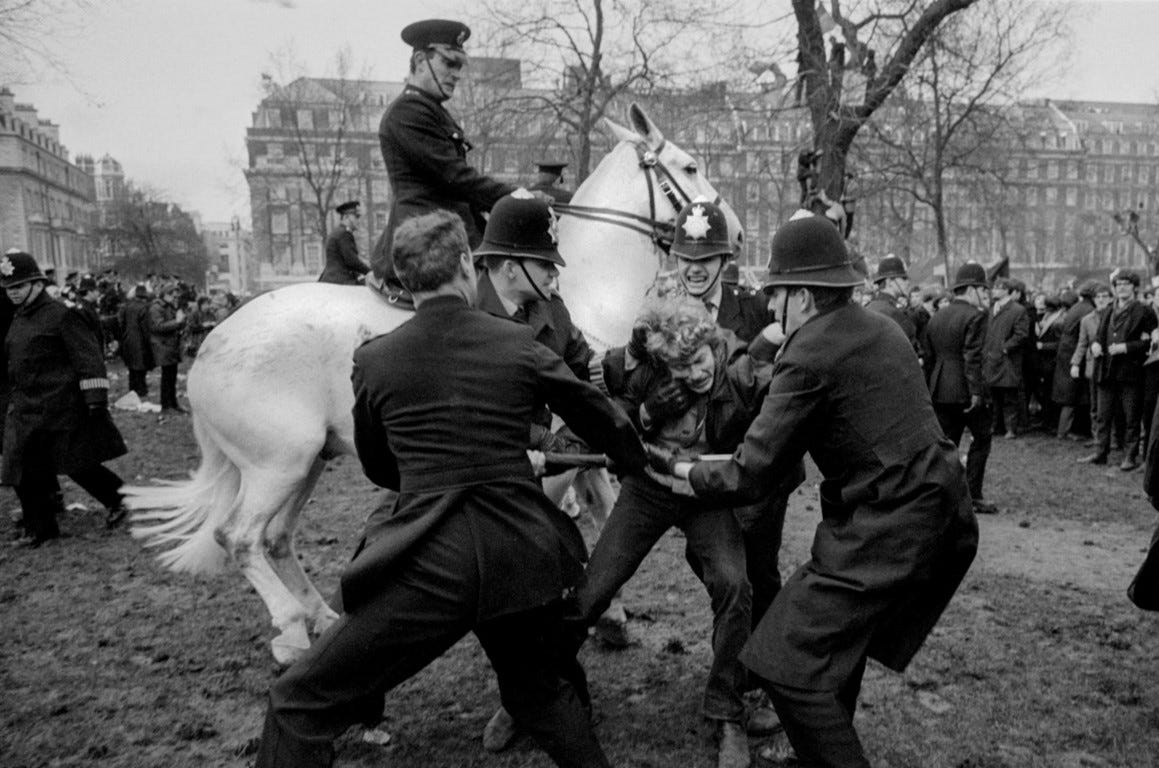
Grosvenor Square, 1968. © David Hurn / Magnum Photos
I’m calling this as the granddaddy of modern British public order disturbances: 1968, the year when young Boomers decided they’d finally had enough of being sexually and politically repressed (man). Protestors demonstrated against the Vietnam war outside the American Embassy in London, whereupon it kicked off and police unleashed their cavalry. A young Mick Jagger, already rock-star famous, was in attendance. You can read Sir Mick’s inchoate ramblings on the riot here.
The results speak for themselves, as England has a very different tradition of violent protest than (say) France: 117 police officers injured, 4 hospitalised and 45 demonstrators receiving medical treatment. Proceedings were brought against 246 demonstrators. The riots were especially consequential, in my view, for three reasons:
Police unpreparedness led to changes in how the Met viewed demonstrations and protests. At Grosvenor square, poorly-equipped officers used dustbin lids as impromptu riot shields.
Grosvenor Square saw middle-class protest movements turn violent in a way that the police hadn’t seen since, possibly, The Suffragettes.
The police decided, due to the unprecedented level of violence, to begin infiltrating activist groups. Which was, of course, messy and controversial.
Southall, 1979
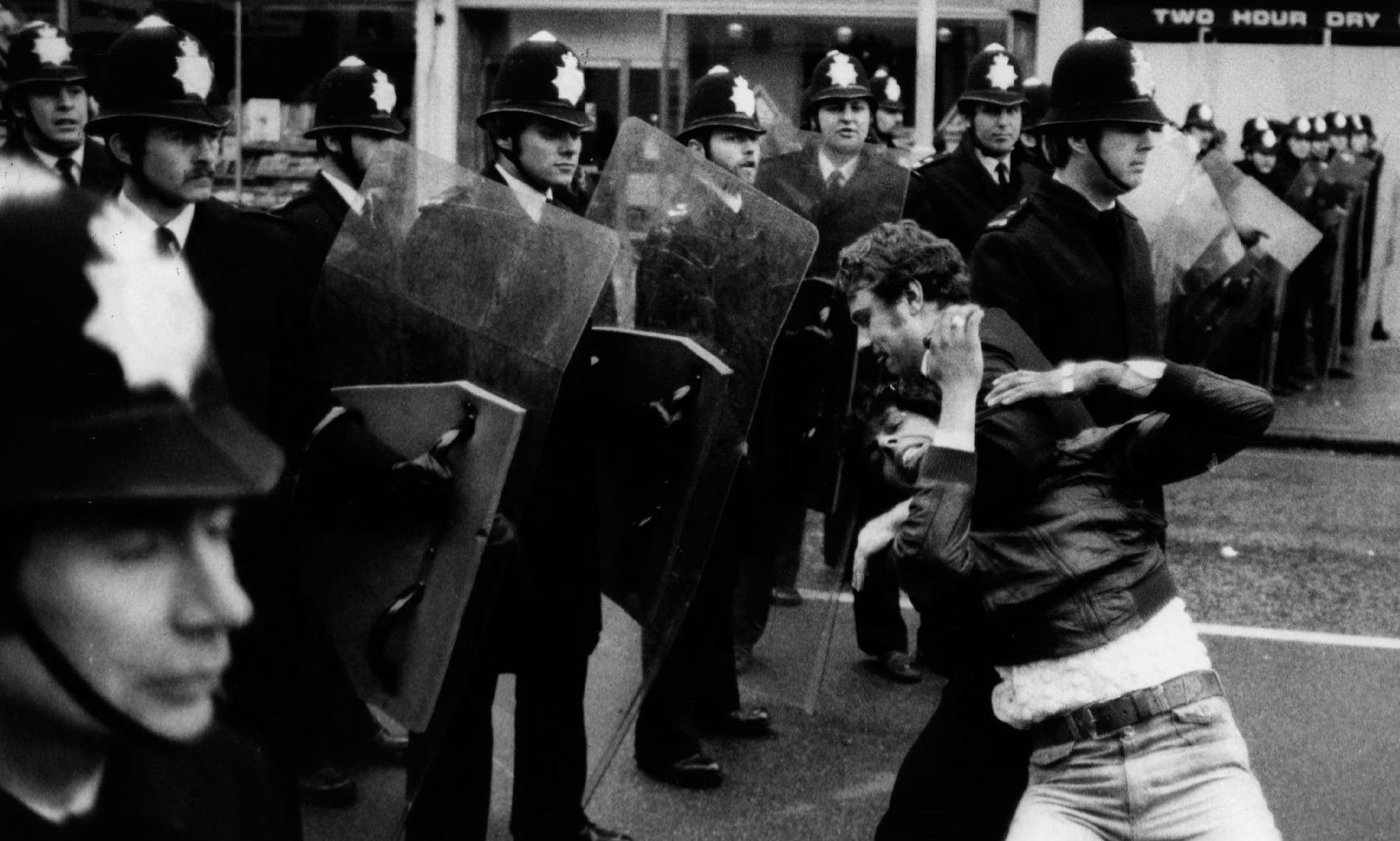
By 1979, nearly a decade after Grosvenor Square, police officers were issued with long shields.
April 1979: a month before the General Election, the neo-Nazi National Front held a deliberately provocative meeting in Southall, the heart of London’s Asian community. The Left, led by the Anti-Nazi League or ANL, counter-demonstrated. As Seventies left-versus-right street politics were wont to do, it kicked off. Nearly 3000 police officers were deployed, including the notorious Special Patrol Group (SPG), who had a reputation for racism and violence. When I joined the Met, in the early Nineties, there were a few old SPG hands left, most of whom were acknowledged to be hard bastards.
Depending on which sources you rely on, between 350 and 700 arrests were made, with 97 officers and 64 members of the public injured. There was also a fatality - a New Zealand-born ANL activist called Blair Peach who was struck on the head by police (this was corroborated by multiple witnesses). No one was ever prosecuted, despite a lengthy investigation into the affair. After 1979, the NF began fading into insignificance as a political force - many on the far-Right believed this was due to Margaret Thatcher spiking their guns by making the right noises on immigration. Nothing changes, does it?
Southall was deeply significant:
The late Seventies and Eighties were perhaps the apogee of hard Left-versus-Right street violence - the model for demonstration and counter-demonstration we are seeing repeat itself today.
Blair Peach’s death led to a new style of activist-driven, legally-assisted police scrutiny. Southall veterans would become formative figures in the campaign around the Stephen Lawrence murder.
Police approaches to public order and race relations began to, albeit slowly, change. In 1987, the SPG was replaced by the Met’s Territorial Support Group to try and signpost cultural change.
Brixton and Toxteth, 1981
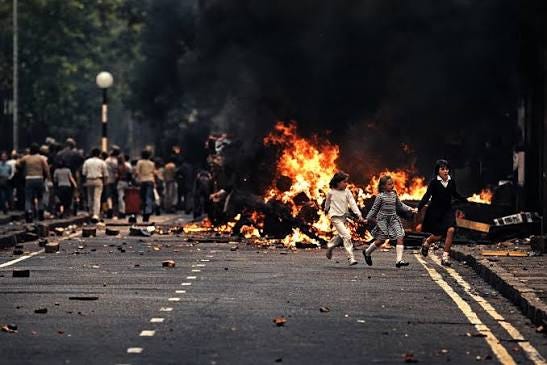
Toxteth burns: even by Eighties standards, the rioting in Liverpool was especially violent.
By 1981, the racial tensions illustrated by Southall finally bubbled over. The inner-city areas of Brixton, in London and Toxteth, in Liverpool, saw serious and sustained rioting. Both involved the black community’s suspicion of police stop-and-search operations. Similarly, both fuses were lit by cases of young black men arrested by police. Brixton exploded in April 1981, Toxteth three months later in July. Both were partly-political expressions of rage, but also featured straightforward looting and criminality.
The riots were marked by their suddenness and ferocity: in Toxteth, a JCB digger was driven at police and CS gas was deployed for the first time on the British mainland. In Brixton, 279 officers were injured. In Toxteth, there were 500 arrests and a man died after being struck by a police vehicle. The riots became landmarks in British race relations and policing:
The Scarman Report was commissioned, with Lord Leslie Scarman scathing about police community relations. Not unlike Macpherson, 18 years later, the report became a benchmark for police approaches to race.
The Home Office displayed its usual distaste for the use of force - such as Merseyside Police’s decision to use tear gas. Strict new guidelines on the deployment of CS and baton rounds were introduced as a result.
Speaking anecdotally, I would say the blood-feud that developed between low-ranking white officers and black youths might have simmered since the Fifties but it boiled over in 1981. At Broadwater Farm, four years later, it finally exploded.
Orgreave, 1984
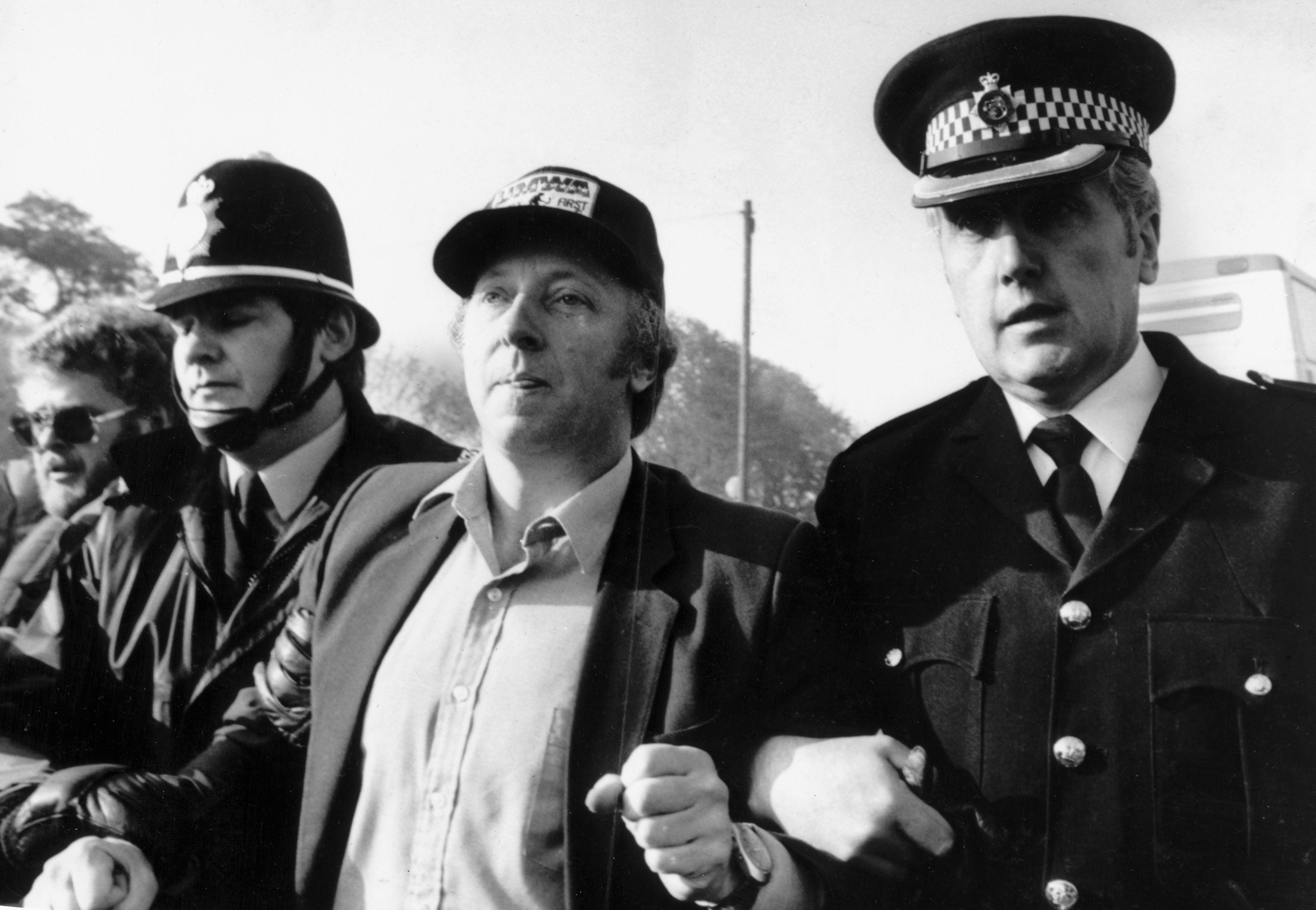
Arthur Scargill, NUM President, has his Waterloo moment… or did he?
For the British Left, the Miners’ Strike of 1984-1985 is their (relatively) bloodless version of the Spanish Civil War. And, to the dewy-eyed trade unionists who still attend the Durham Gala, “The Battle of Orgreave” was its Guernica.
On 18th June 1984, police officers clashed with striking miners at the Orgreave coking plant. The strikers were determined to stop deliveries to the British steel works in Scunthorpe. The police were determined the deliveries would go through. South Yorkshire Police, who led the operation, were determined there would be a show of strength.
As strikers tried to stop the coke lorries leaving the plant, thousands of riot police and mounted officers charged. Running battles ensued, with Arthur Scargill being struck on the head with a riot shield. All of the 95 demonstrators found guilty of offences would later have their convictions quashed at court; police evidence was found to be embarrassingly unreliable. Orgrave shows how:
The police show of strength had backfired - they might have “won” the battle of Orgreave, but at a heavy price.
Margaret Thatcher’s battle with the NUM, whatever its rights or wrongs (and I’ll happily add my personal view that Scargill was a menace), soured police relations with northern, working-class communities for a generation. Indeed, a public inquiry into the matter is ongoing.
The Miners’ Strike led to the 43 English and Welsh police forces coordinating their mutual aid agreements ensuring resilience during major public disturbances. Orgreave’s legacy can be felt today, with talks of a super-forces, a potential national police force and concerns over the cost of policing pro-Palestine and anti-Immigration protests.
Tottenham, 1985
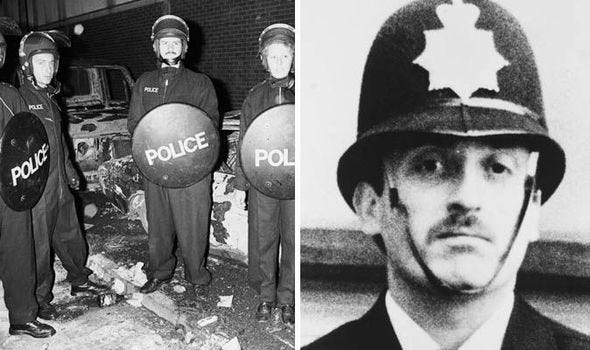
Broadwater Farm, Tottenham, October 1985. Pc Keith Blakelock, who was protecting fire fighters putting out a blaze, was near-decapitated by rioters.
The Eighties saw the police face serious incidences of violent public unrest - from Brixton and Toxteth to the Miners Strike. Then, in 1985, the Met’s already toxic relationship with black Londoners reached its nadir. Tottenham, in North London, enjoyed typically fraught race relations. The Broadwater Farm estate, a brutalist fortress of walkways, plazas and towers, became a forbidding place to patrol. Perennial issues around race, deprivation and the impossibility of “policing by consent” resurfaced, as if another public inquiry might solve tectonic societal change.
Tensions in London were already high, after the police mistakenly shot and killed a woman called Cherry Groce in Brixton. Then, in Tottenham, 49-year old Cynthia Jarrett suffered a heart attack and died while police were searching her home. A protest outside Tottenham police station led to rioting on Broadwater Farm. A ferocious battle between police and gangs of youths saw the brutal murder of Pc Keith Blakelock. Then, another toxic legacy: the three men charged with Pc Blakelock’s murder were found not guilty during another miscarriage of justice.
Broadwater Farm makes my list because:
Scarman failed. The police were now faced with very real challenges to how they policed a multiracial city. For those interested in the period, I’d recommend reading Michael Graef’s oral history of Eighties policing, Talking Blues.
All sides involved now had their martyrs - Cherry Groce and Cynthia Jarrett for the black community, Keith Blakelock for the police. The blood-feud was sealed, antipathy normalised between the Met and young black men. I saw it for myself seven years later. Policing west London’s Afro-Caribbean council estates you could feel the loathing in many interactions with black kids. At the back of many police officers’ minds, the question: would they, given the chance, do a Keith Blakelock on me?
Slap-dash CID work and miscarriages of justice, not unlike Orgreave, characterized the aftermath of Broadwater Farm. Riots cause crises. Crises cause tragedies. Tragedies often cause flawed investigations.
The Poll Tax Riot, 1990
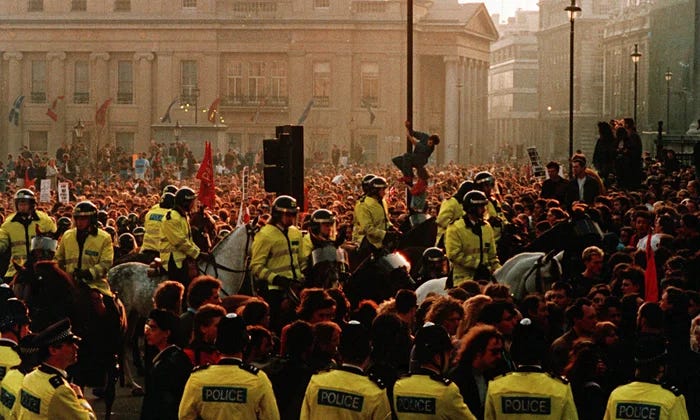
Trafalgar Square, March 1990, the last big demo of the Thatcher era.
The Poll Tax was Margaret Thatcher’s last stand. Her Wounded Knee, or Arnhem Bridge. The hated tax spawned an alliance of campaigners and on 31st March 1990, they gathered in their thousands at Kennington Park in south London. Typically for mass demonstrations, estimates of numbers vary. The 25,000 figure quoted at the time seems too small. Later estimates of 200,000 might be too large.
In any case, a huge crowd marched into central London along a time-honoured route: along Whitehall, passing Number Ten Downing Street and towards Trafalgar Square. By noon, the Met’s Special Branch were reporting “there are 150 anarchists marching under banner 'Freemasons Against Poll Tax' who are under the influence of drink/drugs and have joined rear of march." The anarchists, ironically, were almost certainly more organised than the Met’s command and control.
Trouble started outside Downing Street: there were sit-down protests, scuffles and missiles thrown at police. Protestors were herded into Trafalgar Square. Fires were lit and scaffolding poles seized from building sites. Then commenced a battle royale, or as an old friend who was there said, “the best day out I ever had in my police service.” He was TSG. After all, who joins the riot squad if they don’t fancy going to one?
The official account recorded 339 arrests, 374 injured officers, including 58 requiring hospital treatment, and 86 reported public injuries. Twenty police horses were injured. All sides, of course, blamed the other for starting the trouble.
Again, we see how English political change is often marked by a near-ritual ruckus in Trafalgar Square:
The riot merely confirmed, in the minds of many Tories, that Margaret Thatcher was losing her political marbles: she resigned eight months later.
The police recognised considerable command and control issues. Much work went into correcting them.
Narratives around shadowy conspiracies abounded, as they often do after riots. Yes, extremists pray for demos to “kick off” or “go spiky,” but very few sit around plotting them, like dreadlocked generals, in their cannabis-scented squats. Do they, however, try to orchestrate circumstances whereby conflict with police is near-inevitable, prompting “spontaneous self-defence?” Yes. It’s a fine distinction, but devilishly difficult to prove in a court of law.
Here ends Part One. I hope you enjoyed it. Part Two will arrive soon.
Excellent article Dominic. I was involved in the Toxteth riots and it did change the way Merseyside Police engaged with the black community. Some great Merseyside police officers used their natural skills and abilities (national basketball players) to meet with local communities and it healed wounds and opened up insights into each other’s way of life. Sgt Mike Parker who recently died made a huge difference and so much so that members of the black community from Toxteth came to his recent funeral 40 years later!
Says it all really. Policing the community with empathy and understanding can make such a difference. Sadly chief officers nowadays do not get the importance of community policing.
An excellent and very useful article. Thank you Dominic.
I was a student at the Free State of Manchester Polytechnic in the early 1980s. One man, Mr David Aaronovich, was the National Union of Students El Presidente 1980-82. Back then membership of the NuS was compulsory.
The local 'chapter' took over the library and after more than 2 weeks, decided to hold a vote. Anyone not carrying their NuS card was not allowed in, and then..... we found other Union activists had arrived as 'guests' to vote, fresh from the Gardiner diesel engine factory. Of course.
The whole thing was a stunt, and Mr Aaronovich has carried on ever since.
The point: This is where activism was born, nurtured and used.
I was on an engineering course so had no time between lectures, lab time and study for the NuS. Others (I'm looking 'humanities') acted, but the leadership were rarely around when things got busy. A union led by Totally Workshy Accredited Technocrats, who often end up in Merchant Banking.